
Review By Chris Heide
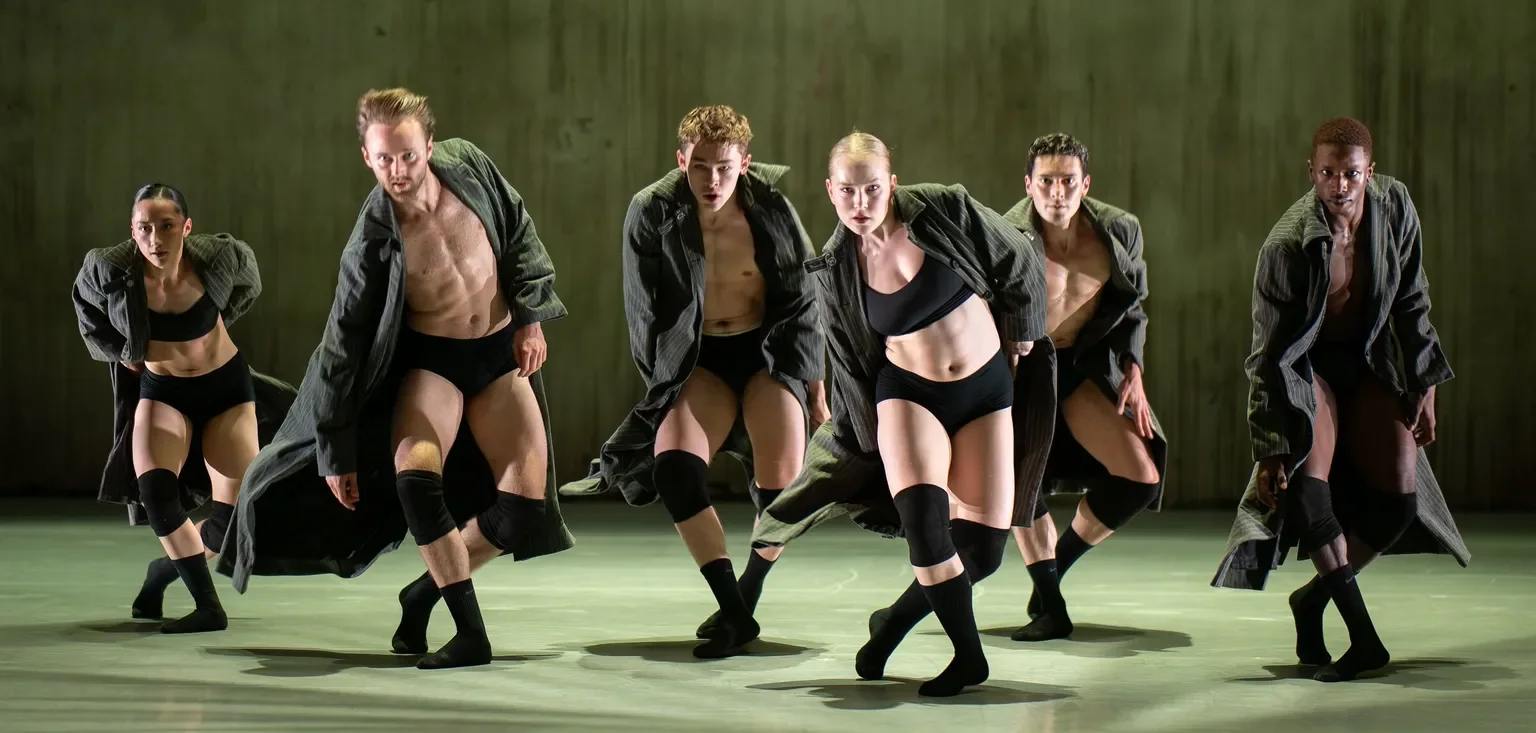
There are dance companies that impress you, and then there are companies like Whim W’Him that leave you grasping for new language entirely. At a certain point, it becomes almost impossible to top yourself in describing the beauty, immersion, talent, creativity, technique, and overall brilliance of the choreography and dancers. Yet somehow, with its Spring 2026 program at the Cornish Playhouse, Whim W’Him managed to do exactly that. This may very well be the strongest collective of dancers the company has assembled in its sixteen-year history. Every performer moved with astonishing precision, emotional intelligence, and technical command through some of the most demanding choreography the company has ever staged.
The evening opened with Static Bloom by James Gregg, one of the most original works Whim W’Him has produced in recent memory. Pulsing with elements of hip-hop, electronic music, and club-inspired movement, the piece captures the euphoric, communal feeling of losing yourself on a dance floor. Beneath that kinetic energy, however, is something far more profound. Gregg’s choreography suggests that joy can emerge from the noise and chaos surrounding us when we allow ourselves to be fully present in the moment. The staccato fragmentation of movement and emotion gradually melts into something ecstatic, euphoric, and deeply human. The musicality was razor sharp, but the emotional resonance is what lingered. It felt contemporary in the truest sense of the word: modern, vulnerable, queer, joyful, and alive.
The second piece, Black Moon by Rena Butler, shifted the evening into more intimate emotional territory. The work unfolds like a meditation on loneliness, grief, and the aching disconnection that can emerge after love. Butler explores the push and pull between connection and isolation with extraordinary sensitivity, allowing moments of tenderness to dissolve almost as quickly as they appear. The musicality moved between the intimate and the epic, feeding directly into the nostalgic and emotional atmosphere of the piece. There was something hauntingly familiar about it, as though Butler had somehow captured the emotional residue left behind by relationships we never fully recover from. By the final moments, I found myself in tears.
The program closed with Dark Echoes Come Shining by Olivier Wevers, a breathtaking exploration of the coexistence of darkness and light. Through stunning lighting design and fluid, organic choreography, the piece examines the bravery required to embrace both joy and suffering as essential parts of being alive. It is unquestionably one of Wevers’ strongest works. Few choreographers craft fluid partner work with the same level of beauty, trust, and emotional precision as Wevers, and that mastery was on full display here. Bodies folded into one another with astonishing softness and trust, creating movement that felt less choreographed than spiritually interconnected. The juxtaposition between shadow and illumination became almost transcendent by the final sequences.
What ultimately makes this company so exceptional is the sheer caliber of technique onstage. These are extraordinarily advanced pieces, requiring immense athleticism, musical precision, emotional nuance, and trust between dancers. Every single artist executed the choreography brilliantly. More importantly, the connective thematic threads between all three works created an emotional progression throughout the evening. Joy, grief, intimacy, isolation, darkness, hope, and transcendence all emerged as part of one larger human experience.
Perhaps the clearest sign of just how extraordinary this evening was came from the audience itself. Every single piece received a standing ovation. Not just the finale, but after each individual work. I have never seen that happen at a Whim W’Him performance before, nor at any other performance I’ve attended in Seattle. The response felt less like polite admiration and more like collective awe. The audience understood they were witnessing something rare.
Whim W’Him continues to prove not only why it remains one of Seattle’s most vital arts organizations, but why contemporary dance itself remains one of the most emotionally powerful forms of storytelling.
